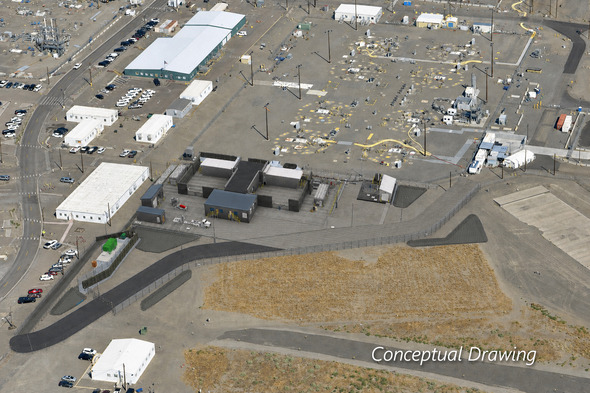
Conceptual rendering of the planned Advanced Modular Pretreatment System near AP Tank Farm. Courtesy of the U.S. Department of Energy.
Hanford is already turning tank waste into glass. So why does it need another treatment system?
The answer starts with what happens before the waste reaches the melters.
On Oct. 30, the U.S. Department of Energy announced that site preparation had begun for the Advanced Modular Pretreatment System, or AMPS. Planned near AP Tank Farm in Hanford’s 200 East Area, the system will expand the site’s ability to prepare liquid tank waste for further treatment.
What is pretreatment?
Hanford’s underground tanks contain a mixture of radioactive and chemical waste left from decades of plutonium production. Preparing the liquid portion for treatment involves separating out undissolved solids and removing radioactive cesium.
Hanford already does this through its Tank-Side Cesium Removal System, known as TSCR. Filters capture solids, while specialized material inside vessels called ion exchange columns capture cesium from the liquid.
The resulting liquid is called low-activity waste. It still requires treatment and disposal. The removed cesium also remains radioactive and must be managed separately.
Pretreatment and vitrification serve different purposes: pretreatment separates materials from the waste, while vitrification mixes pretreated waste with glass-forming materials and heats it to produce a stable glass waste form.
How will AMPS build on the existing system?
AMPS will perform the same basic pretreatment functions as TSCR, with greater capacity.
DOE says the expanded tank-side pretreatment capability will allow Hanford to prepare a combined 3.6 million gallons of waste annually, three times the current pretreatment capacity. That figure describes pretreatment capacity, rather than the amount of waste that will be turned into glass each year.
Initial site preparation includes utility relocation, support trailers, electrical improvements and road work. These activities prepare the area for the new system; AMPS is not yet operating.
Why does capacity matter?
Tank-waste cleanup depends on a series of connected steps: retrieving waste, preparing it for treatment, turning it into a stable solid and disposing of it. Progress depends on how those steps work together.
An October DOE update illustrates that connection. After completing a batch of pretreatment, TSCR was ready for another run but needed to wait for space in the tank that receives its processed liquid. More room would become available as pretreated waste moved onward for treatment.
Additional pretreatment capacity is therefore one part of the broader cleanup effort. Storage, treatment and disposal capacity also matter.
DOE plans for AMPS to support both vitrification and grouting of appropriate waste streams. Grouting uses a cement-like mixture to solidify waste. These are separate treatment pathways, with each requiring their own planning, regulatory oversight and approval.
What does this mean for our community?
For our community, understanding AMPS helps put individual cleanup announcements into context.
Beginning site preparation is a step toward expanded pretreatment capability. The longer-term measure of progress will be how that capability supports waste moving through treatment and into disposal. Hanford Communities will continue following these connected efforts and helping explain what they mean for the cleanup mission our region shares.