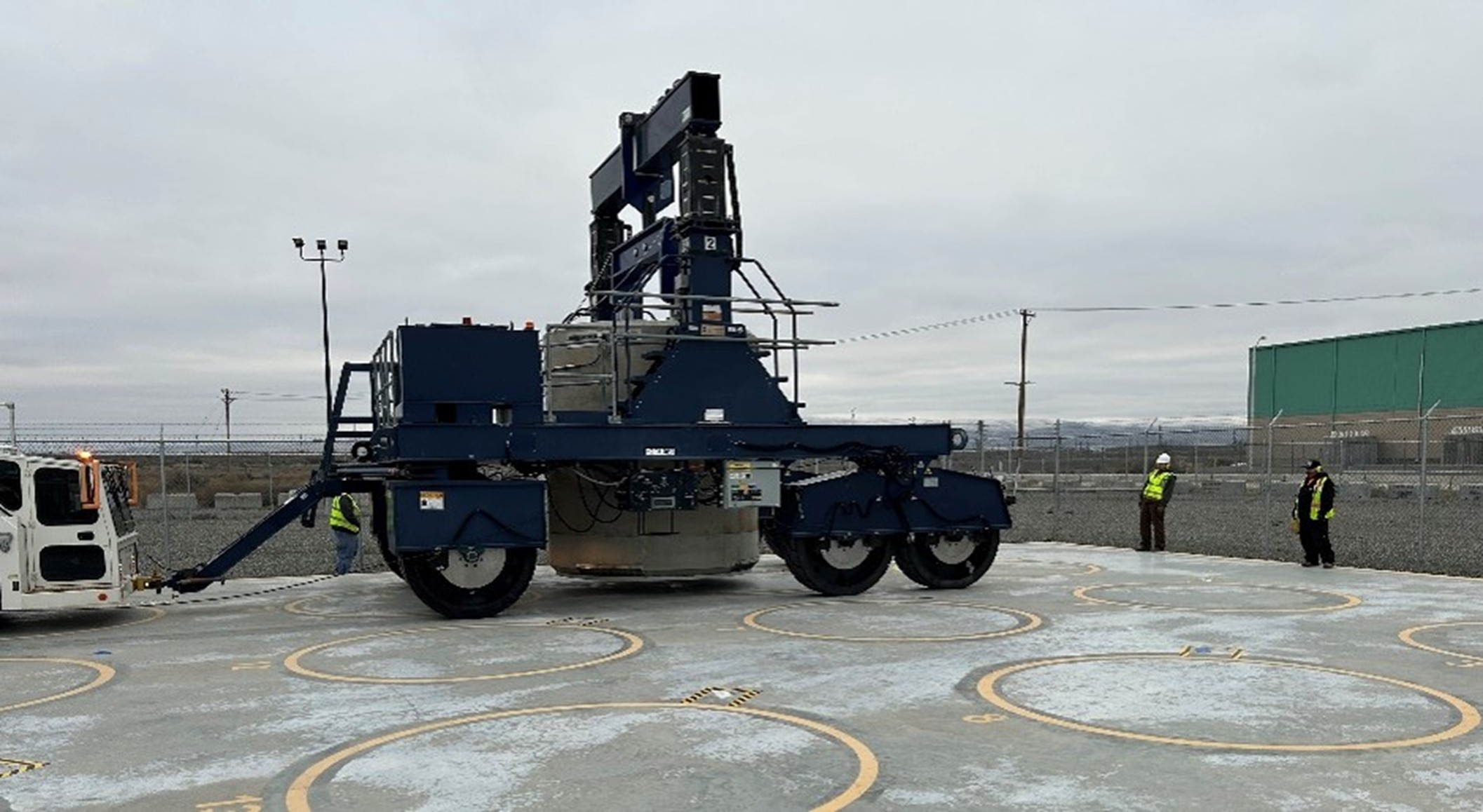
A concrete cask filled with radioactive capsules is placed on an interim dry storage pad near the Waste Encapsulation and Storage Facility at the Hanford Site.
Photo courtesy of Central Plateau Cleanup Company / U.S. Department of Energy.
Some of Hanford’s most important cleanup progress happens through steady, carefully planned work that reduces long-term risk over time.
One example is the project underway at the Waste Encapsulation and Storage Facility, known as WESF, where the U.S. Department of Energy and its contractors are moving 1,936 highly radioactive cesium and strontium capsules from underwater storage to an interim dry storage pad.
The project is a major step in reducing risk at one of Hanford’s aging facilities and preparing the site for the next phase of cleanup.
What is WESF?
WESF has provided safe and compliant underwater storage for Hanford’s cesium and strontium capsules for more than 50 years.
The capsules date back to Hanford’s plutonium production era. In the early 1970s, cesium and strontium were removed from Hanford’s underground tanks to help reduce the temperature of the waste inside. Those materials were then placed into sturdy stainless-steel capsules so they could be safely stored and monitored.
Although the capsules are relatively small compared with the large tanks and facilities often associated with Hanford cleanup, they contain a significant amount of radioactivity, representing about one-third of the total radioactivity on the Hanford Site.
For decades, the capsules were stored underwater inside WESF. The water provided shielding from radiation and helped manage heat from the capsules. The blue glow sometimes seen in the storage pools is known as Cherenkov radiation. It occurs when radiation interacts with the water around the capsules.
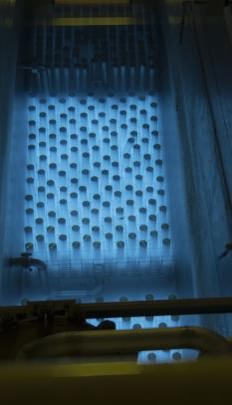
Photo courtesy of Central Plateau Cleanup Company/U.S. Department of Energy.
What is changing?
In October 2025, workers began moving the capsules out of the water-filled basin and into engineered concrete casks for dry storage.
The work is highly controlled and performed using remote equipment inside the facility. Workers place the capsules into large concrete casks, with each cask designed to hold up to 132 capsules. Once a cask is filled, it is moved to a nearby concrete storage pad.
The first batch of capsules was successfully transferred from underwater storage to dry storage in January 2026, marking a major project milestone. Over the next several years, the remaining capsules will be transferred into dry storage.
The full transfer is expected to be completed by September 2029.
Why move the capsules to dry storage?
Underwater storage at WESF has served its purpose for decades. But WESF is an aging facility, and moving the capsules to dry storage reduces the long-term risk associated with relying on water-filled storage pools. It also allows the capsules to be stored in a more passive configuration, with engineered concrete casks providing shielding and cooling.
Moving the capsules to dry storage also supports the goal of shrinking the overall cleanup footprint at Hanford. Once the capsules are removed from the facility’s basins, WESF can move closer to its future cleanup and deactivation path.
In plain language, this project moves some of Hanford’s most radioactive material from an older water-based storage system into a more stable interim storage setup.
Why this matters for Hanford cleanup
Hanford cleanup is often described through large milestones, such as treating tank waste, demolishing old facilities, cleaning up contaminated groundwater or preparing waste for disposal. The WESF capsule transfer project is part of that same long-term cleanup picture.
It matters because it addresses one of the site’s most concentrated sources of radioactivity. It reduces reliance on an aging facility. It also moves Hanford closer to eventually deactivating WESF, which is an important step in reducing long-term facility risks across the site.
For local communities, the project is another example of cleanup progress that may not always be visible from outside the site but has long-term importance. Each cask moved to dry storage represents another step toward reducing risk and preparing Hanford facilities for the future.
What happens next?
Workers will continue transferring capsules from WESF into engineered concrete casks and moving the filled casks to the interim dry storage pad near the facility.
According to current project information, crews are actively preparing and loading additional casks as the transfer campaign continues. The work is expected to continue over the next several years, with completion currently expected by September 2029.
Hanford Communities will continue following this work as part of its broader effort to share plain-language updates on Hanford cleanup progress, public involvement opportunities and issues that affect the Tri-Cities region.